
 CA
TABLE OF CONTENTS
Stair Railing Height Code: Standard Handrail and Guardrail Heights

The standard height for a stair handrail is usually 34 to 38 inches, but this does not mean every railing should be installed at the same height.
Before ordering a railing system, determine where it will be installed, how the building is used, and whether the project needs a handrail, a guardrail, or both.
In simple terms:
-
A handrail is designed to be grasped while using stairs or a ramp.
-
A guardrail protects open edges on stairs, decks, balconies, and landings.
Under common U.S. model building codes, residential guardrails are usually at least 36 inches high, while commercial guardrails are usually at least 42 inches high. ADA, OSHA, and local requirements may also apply to certain projects.
Railing Height Requirements at a Glance
|
Application |
Common Height |
How It Is Measured |
|
Residential or commercial stair handrail |
34–38 inches |
From the stair-nosing line to the top of the gripping surface |
|
ADA stair or ramp handrail |
34–38 inches |
From the stair nosings or ramp surface to the top of the gripping surface |
|
Residential guardrail on a level deck, balcony, or landing |
36 inches minimum |
From the adjacent walking surface to the top of the guardrail |
|
Residential guardrail on the open side of stairs |
34 inches minimum |
From the stair-nosing line to the top of the guardrail |
|
Commercial guardrail |
42 inches minimum |
From the adjacent walking surface or stair-nosing line |
|
OSHA workplace guardrail |
42 inches ± 3 inches |
From the walking-working surface to the top edge |
|
OSHA workplace handrail |
30–38 inches |
From the leading edge of the stair tread to the top of the handrail |
These figures summarize common U.S. requirements. Always confirm the code edition and local amendments adopted for your project.
What Is the Difference Between a Handrail and a Guardrail?
A handrail and a guardrail may be part of the same railing system, but they serve different purposes.
A handrail provides a graspable surface for balance and support. A guardrail forms a protective barrier along an open edge to help prevent falls.

On some stairs, the top rail of a guardrail may also serve as the handrail. To do so, it must meet the applicable requirements for height, continuity, and graspability.
A 42-inch commercial guardrail is usually too high to function as a 34- to 38-inch handrail. In that situation, a separate graspable handrail may be required.
How Is Railing Height Measured?
Railing height is measured vertically. The installation area determines the starting point, while the railing type determines the ending point.
Measurement Starting Point
On stairs, measure from the sloped line connecting the leading edges of the stair treads. On a deck, balcony, or landing, measure from the adjacent level walking surface. On a ramp, measure from the ramp surface.
Measurement Ending Point
For a handrail, measure to the top of the gripping surface. The thickness of the handrail is included in the finished height.
For a guardrail, measure to the top of the guardrail.
|
Installation |
Starting Point |
Ending Point |
|
Stair handrail |
Stair-nosing line |
Top of the gripping surface |
|
Stair guardrail |
Stair-nosing line |
Top of the guardrail |
|
Deck or balcony guardrail |
Level walking surface |
Top of the guardrail |
|
Ramp handrail |
Ramp surface |
Top of the gripping surface |

Residential Stair Handrail Height
Under common International Residential Code (IRC) requirements, residential stair handrails are generally installed 34 to 38 inches above the stair-nosing line.
The measurement ends at the top of the handrail’s gripping surface—not at the bottom of the rail, the bracket, the post, or the stair stringer.
Guardrails around residential decks, balconies, and landings are generally at least 36 inches high. A guardrail on the open side of residential stairs may be at least 34 inches high.
If the top of a stair guardrail also serves as the handrail, it generally needs to remain within the 34- to 38-inch handrail range and meet the applicable graspability requirements.
Commercial Railing Height

The International Building Code (IBC) generally requires commercial stair handrails to be 34 to 38 inches high.
The 42-inch height commonly associated with commercial railings usually applies to guardrails, not graspable handrails.
A commercial stair may therefore require both:
-
A 42-inch guardrail to protect the open side of the stair
-
A 34- to 38-inch handrail for grasping and support
The exact configuration depends on the building’s use, stair design, locally adopted code edition, and any applicable exceptions.
ADA Handrail Height Requirements
The ADA Accessibility Standards help ensure that stairs, ramps, and walking areas in public facilities are accessible to people with disabilities. ADA requirements do not generally apply to an ordinary private home, but they may apply to public buildings and certain commercial projects.
Under the ADA Standards, the top of a handrail’s gripping surface must be 34 to 38 inches above the stair nosings or ramp surface.
ADA requirements also address handrail continuity, graspability, wall clearance, and extensions. Section 505 requires at least 1½ inches of clearance between the handrail gripping surface and an adjacent wall.
Meeting the 34- to 38-inch height range alone does not make an entire handrail system ADA compliant.
OSHA Workplace Requirements
OSHA workplace safety requirements are intended to protect employees in locations such as factories, warehouses, and work platforms. They do not replace the residential or commercial building codes that apply to a building project.
Under OSHA 29 CFR 1910.29:
-
The top edge of a workplace guardrail is generally 42 inches ± 3 inches above the walking-working surface.
-
A handrail must generally be 30 to 38 inches above the leading edge of the stair tread.
-
Stair rail systems installed on or after January 17, 2017, must generally be at least 42 inches high.
Under OSHA, guardrail systems, stair rail systems, and handrails are different components. The top rail of a stair rail system can serve as a handrail only when it also meets the applicable height and graspability requirements.
Deck and Outdoor Stair Railing Height

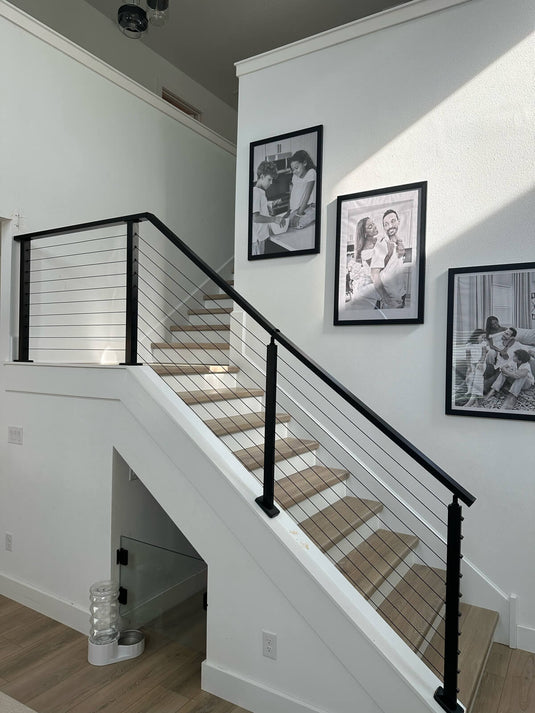
A cable railing system around a residential deck, balcony, or landing usually functions as a guardrail. The common minimum height is 36 inches.
Outdoor stairs may need both a guardrail to protect the open side and a graspable handrail to support people using the stairs.
If the top rail of a cable railing system is too high, difficult to grasp, or not continuous, a separate handrail may be required.
How to Choose the Right Cable Railing System
Before buying a railing system, determine whether it will be installed on stairs, a deck, a balcony, a landing, or a ramp. You should also confirm whether the project is residential or commercial. These factors affect the required railing type, finished height, and component selection.
Next, consider the following questions:
-
Do you need a handrail, a guardrail, or both?
Cable railing around a level deck, balcony, or landing usually functions as a guardrail. A stair project may need both fall protection and a graspable handrail. -
What will the finished height be?
Do not choose a system based only on the listed post height. The base, top rail, top-mount or side-mount configuration, and stair angle can all affect the finished height. -
Are the posts and fittings suitable for the installation direction?
Level and stair posts are not always interchangeable. Stair installations require posts, cable holes, brackets, and terminals designed for an angled run. -
Does the system meet local requirements?
States, cities, and counties may adopt different code editions or add local amendments. Confirm local requirements before purchasing products for a commercial property, rental property, or permitted project.
Muzata offers products for both level and stair installations:
-
Cable Railing Posts
-
Handrails
-
All-in-One Cable Railing Systems
-
Cable terminals and installation tools
Make sure the posts, top rails, cable terminals, and installation hardware are compatible with the mounting method, material, and angle of your project.
Frequently Asked Questions
What is the standard height of a stair handrail?
The common handrail height for residential and commercial stairs is 34 to 38 inches above the stair-nosing line.
Should a railing be 36 or 42 inches high?
Residential guardrails on level walking surfaces are generally at least 36 inches high. Commercial guardrails are generally at least 42 inches high. The correct requirement depends on the building use and locally adopted code.
Does a commercial handrail need to be 42 inches high?
Usually not. The 42-inch requirement generally applies to commercial guardrails. Commercial stair handrails are usually 34 to 38 inches high.
Are deck stair handrails and indoor stair handrails different heights?
The common handrail height is generally 34 to 38 inches for both indoor and outdoor stairs. Other requirements may vary according to the building use and local code.
Conclusion
The common height for a stair handrail is 34 to 38 inches. Residential guardrails on level walking surfaces are generally at least 36 inches high, while commercial guardrails are generally at least 42 inches high. OSHA uses separate requirements for workplace safety.
Before ordering a railing system, confirm the installation area, building use, finished height, mounting method, and locally adopted requirements.
Official References